
A Hidden Camera on Your Street Logs Every Car That Drives By. Now Americans Are Fighting Back.
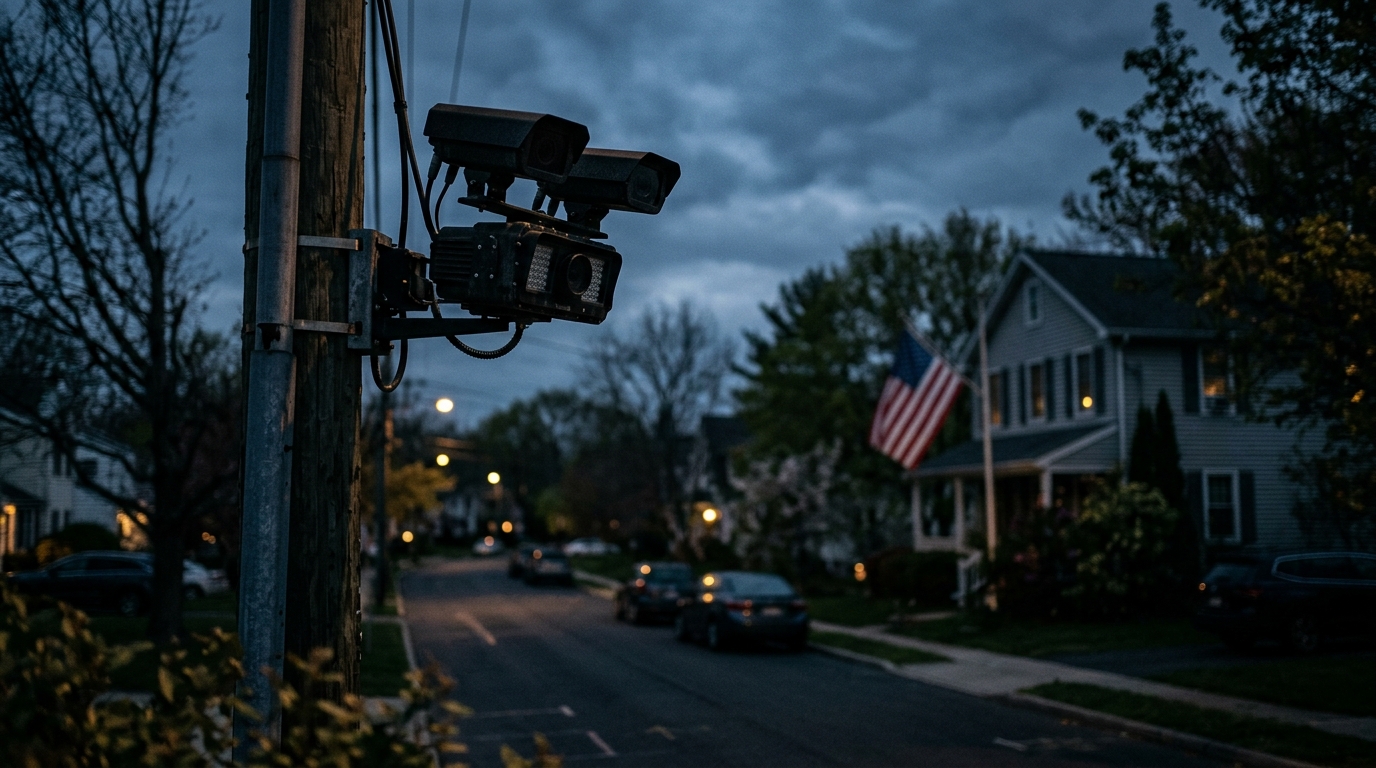
Picture a camera on a pole at the end of your street. Every time a car passes, it snaps a photo and records the plate, the make, the model, the color, and the little details, the roof rack, the dent, the bumper sticker. Then it files all of that into a searchable national database. A police officer three states away could type in a description as specific as a gray pickup with a flag decal and a cracked taillight and pull up everywhere that truck has been.
That is not a movie. It is a company called Flock Safety, and there are more than 120,000 of its cameras across America right now. And for the first time, people on the left and the right are united in wanting them gone.
What these cameras actually do
Start with the scale, because most people have no idea.
Flock is an Atlanta company valued around 7.5 billion dollars. Its automated license plate readers, mounted on poles along roads, in neighborhoods, and outside businesses, photograph every vehicle that passes and use AI to log not just the plate but a full vehicle signature, down to bumper stickers and scratches. That information flows into a nationwide network that thousands of agencies can search, often with no warrant and no reason beyond wanting to look. Flock says it does not use facial recognition, and that is true. But it does not need your face when it can track your car everywhere you take it.
Police departments love it, and they are not wrong that it works. Officers have used Flock to catch killers within half an hour, recover stolen cars, and find missing children. That is real, and it deserves to be said plainly. Nobody serious wants criminals to get away.
Why the backlash crosses party lines
Here is what makes this story different from the usual fight.
This is not left versus right. It is a genuine bipartisan revolt, and each side got there its own way. Conservatives look at a warrantless dragnet logging the movements of millions of law-abiding Americans and see exactly the kind of surveillance state the Fourth Amendment was written to stop. A town near Austin that voted for Trump by 20 points killed its Flock contract on a unanimous vote. On the left, cities like Denver and Cambridge pulled the plug over fears the data would be handed to federal immigration agents. Different worries, same conclusion. Between 2021 and this spring, 82 Flock contracts were cancelled across 28 states.
When the ACLU, libertarian law firms, and Trump-country city councils all land in the same place, something real is happening.
The abuses are not hypothetical
This is the part that should bother everyone, whatever your politics.
The stories keep piling up. In Ohio, two officers resigned after one was found to have used the system more than 40 times to track a former partner. Three Arizona cities are investigating officers, including one accused of using the cameras to follow his own wife. Police in Georgia and South Carolina were fired for misuse. A sheriff's office in Texas reportedly used it to track a woman suspected of getting an abortion. And a libertarian legal group has now catalogued more than 100 documented cases of abuse, from stalking to wrongful stops.
The pattern is always the same. A tool sold to catch criminals becomes a tool to watch ordinary people, because once the data exists, someone will misuse it. That is not a bug in the system. It is the predictable result of building the system at all.
Flock's answer, and why critics are not buying it
To its credit, the company is feeling the heat and responding.
This month Flock announced it would cut how long it stores data from 30 days to as little as 7, make misuse detection mandatory, and add tools to flag suspicious searches. Those are real changes. But privacy advocates were blunt in calling them window dressing. Their argument is that the problem is not the settings, it is the business model. A company whose entire product is a nationwide, interconnected surveillance web is always going to generate the kind of access that gets abused. Tweaking the retention clock does not change what the machine is.
What to watch next
A few fronts will decide how this plays out.
Watch the courts. The ACLU is pressing a Fourth Amendment case arguing that warrantless plate tracking violates the Constitution. If a federal appeals court agrees, it could reshape the whole industry.
Watch your own city council. This fight is being won and lost locally, one contract at a time. The town-hall meeting most people skip is exactly where these cameras get approved or killed.
Watch the states. Lawmakers in both parties are writing bills to limit how long the data is kept, who can see it, and whether federal agencies get access at all.
One last thing worth saying. Some frustrated people have taken to blocking or wrecking the cameras themselves, and you can understand the anger. But smashing a camera is a crime that changes nothing and hands the other side an easy villain. These cameras came in through votes and contracts, and that is how they go back out. The revolt that actually works is the boring one. Show up, and make your representatives choose.
Support Truth in Media
If you believe in our mission to bring honest, conservative news to the American people, please consider joining our newsletter.
Join The Movement